
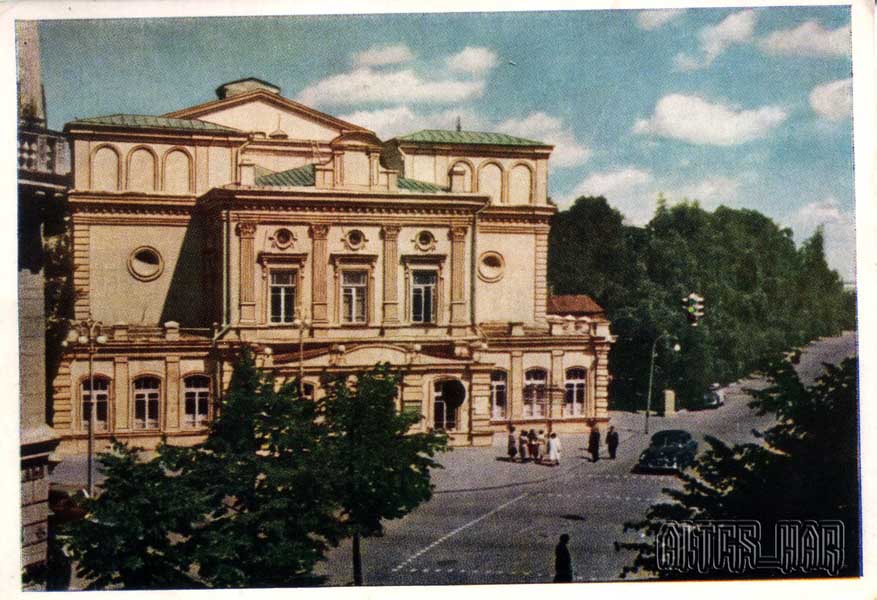
A retrospective postcard from 1956 showcasing the building of the Yanka Kupala State Academic Theatre in Minsk.
What is shown on the postcard
The postcard depicts the main facade of the theatre building featuring classical architectural elements. At the center is a three-story volume with pilasters, arched, and circular windows. A group of people is gathered near the entrance, and a dark-colored passenger car is visible on the street to the right. Tree crowns occupy the foreground, and the dense foliage of Alexander Park is visible on the right.
Historical note
The theatre building was constructed in 1890 in the city park based on a design by architects K. Kozlowski and B. Gerbec. In 1920, the Belarusian State Theatre (BDT-1) opened here, and in 1944, it was named after the classic of Belarusian literature, Yanka Kupala. The building underwent reconstruction after the Second World War.
Present day
Between 2010 and 2013, a large-scale reconstruction was carried out, restoring the theatre’s original late-19th-century historical appearance that had been altered during post-war Soviet remodeling. Today, the Yanka Kupala National Academic Theatre is Belarus’s leading drama stage.
Location (map)
Address: 7 Engelsa St, Minsk, Belarus
Coordinates: 53.901625, 27.562719
(Google Maps)
Coordinate source: Coordinates of the Yanka Kupala National Academic Theatre building.
Questions and answers
- In what year was the theatre building constructed? The original theatre building was constructed in 1890.
- When was the theatre named after Yanka Kupala? The theatre was named after the prominent Belarusian poet Yanka Kupala in 1944.
- What changes did the building undergo in the 21st century? Between 2010 and 2013, the building was restored to its original late-19th-century appearance.
See also
The «Old Postcards» archive includes other views of Minsk from 1956.

Reviews
There are no reviews yet.