

A 1958 postcard featuring the building of the “Volna” Children’s Sanatorium in Feodosia, known as the former Stamboli Dacha.
What is shown on the postcard
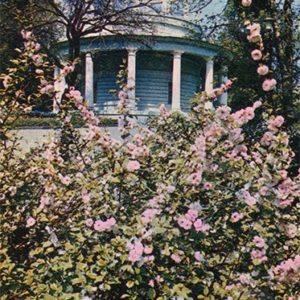
The postcard shows the facade of the building, constructed in the Moorish style, partially obscured by green foliage. Characteristic architectural elements such as turrets, arched windows, and decorative cornices are visible.
In the foreground, there is a stone fence and a lamppost.
Historical note
The building, later known as the “Volna” Children’s Sanatorium, was originally built between 1909 and 1914 as a dacha for the tobacco manufacturer Iosif Stamboli, designed by architect Oscar Vezhi. After nationalization during the Soviet era, it housed various sanatoriums, including a children’s sanatorium for tuberculosis treatment, which was named “Volna” (Wave).
Present day
Currently, the former Stamboli Dacha is a cultural heritage site. After a long period of disuse, the building has been restored and now operates as a hotel and restaurant complex, preserving its historical appearance.
Location (map)
Address: Genoese Street, 3, Feodosia
Coordinates: 45.022980, 35.390820
(Google Maps)
Coordinate source: Coordinates obtained from Google Maps data for Stamboli Dacha, Feodosia..
Questions and answers
- What is depicted on the postcard? The postcard depicts the building of the “Volna” Children’s Sanatorium in Feodosia, known as the former Stamboli Dacha.
- Who was the original owner of the building? The original owner of the building was the tobacco manufacturer Iosif Stamboli.
- What was located in the building during the Soviet era? During the Soviet era, various sanatoriums were located in the building, including the “Volna” Children’s Sanatorium.
See also
The «Old Postcards» archive includes other views of Feodosia from 1958.

Reviews
There are no reviews yet.