
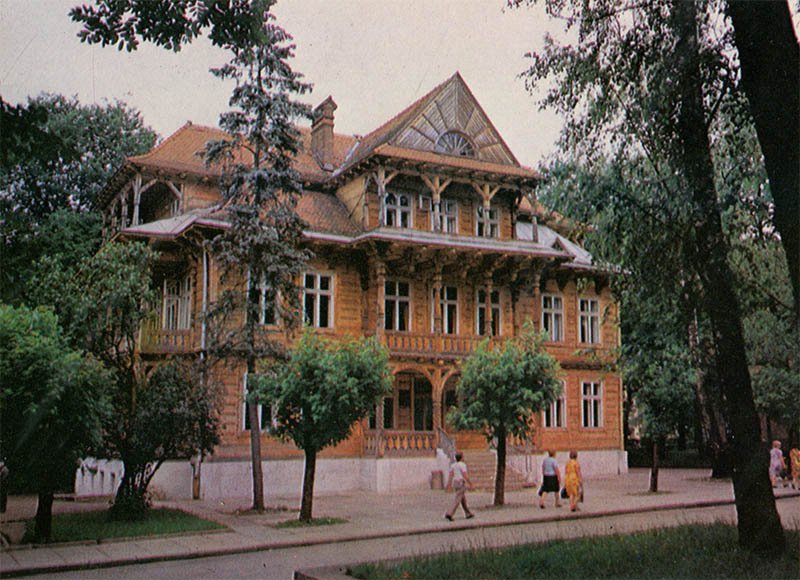
This 1982 Soviet postcard shows a historic wooden building in Truskavets, labeled on the original print as the ‘Administrative Building’.
What is shown on the postcard
The image captures a three-story wooden building featuring distinct carved details, balconies, and a decorative gable in the Carpathian resort style. Young deciduous trees and a spruce grow in front of it. Pedestrians in summer clothing walk along the paved sidewalk.
Historical note
This landmark is the famous Villa Goplana, built in 1925 in the tradition of wooden resort architecture with Swiss style and Art Deco influences. Before World War II, it served as the residence of Raymond Jarosz, the mayor and owner of the Truskavets resort. During the Soviet period, it housed the resort’s administrative offices.
Present day
In 1992, the former villa became the Mykhailo Bilas Art Museum, dedicated to the prominent Ukrainian textile artist. The building has been fully preserved in its authentic state and is protected as a local architectural monument.
Location (map)
Address: Kobzariv Square, 3, Truskavets, Lviv Oblast, Ukraine
Coordinates: 49.278546, 23.504193
(Google Maps)
Coordinate source: Coordinates of the Villa Goplana (currently the Mykhailo Bilas Art Museum) in Truskavets..
Questions and answers
- Which building is shown on the postcard? The postcard depicts Villa Goplana, a prominent wooden architectural monument in Truskavets built in 1925.
- Why is it labeled as an administrative building on the 1982 postcard? During the Soviet era, the historical villa housed the central administrative offices of the Truskavets resort.
- What occupies this building today? Since 1992, the villa has housed the Art Museum of Mykhailo Bilas, a renowned Ukrainian textile artist.
See also
The «Old Postcards» archive includes other views of Truskavets from 1982.

Reviews
There are no reviews yet.