
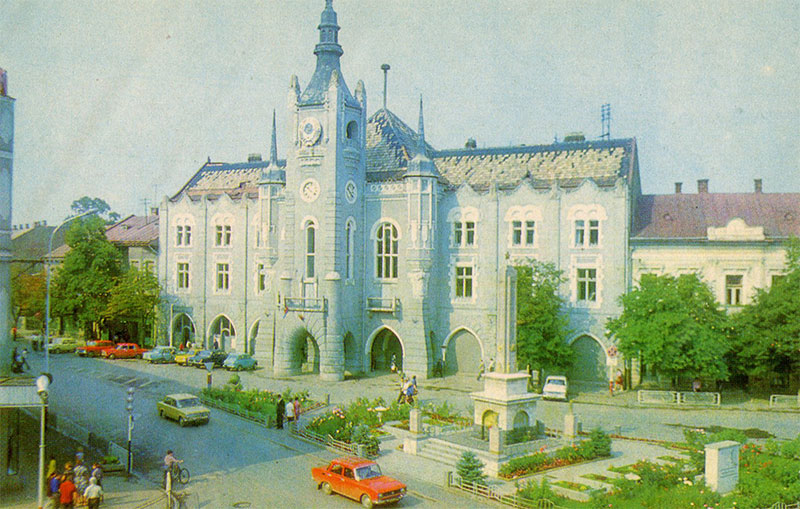
This 1979 Soviet postcard features the city hall (Rathaus) of Mukachevo, located on the city’s central square.
What is shown on the postcard
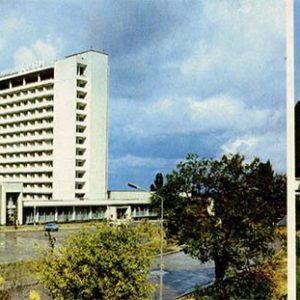
The image captures the three-story Art Nouveau (Secession) town hall building with its distinctive corner tower, clock, and arched ground-floor passages. In front of the building, there is a green square with flowerbeds, Soviet passenger cars (including a red VAZ-2101), and pedestrians. A granite obelisk is visible on the right side of the frame.
Historical note
The Mukachevo Town Hall was constructed in 1903–1904 according to the design of the Hungarian architect János Babula Jr. The building is an architectural monument and the main symbol of the city. The obelisk erected in front of the town hall to honor Soviet soldiers who died in World War II was unveiled in the post-war years.
Present day
Today, the town hall building continues to serve its administrative purposes, housing the city council. The exterior facade has been restored and preserved. The Soviet war memorial obelisk in front of the building was dismantled in 2022 as part of derussification and decolonization efforts, and the soldiers’ remains were reburied in the central cemetery.
Location (map)
Address: 2 Yaroslava Mudroho St, Mukachevo, Zakarpattia Oblast, Ukraine
Coordinates: 48.441180, 22.718816
(Google Maps)
Coordinate source: Coordinates of the Mukachevo Town Hall (Yaroslava Mudroho St, 2).
Questions and answers
- When was the town hall built? The Mukachevo Town Hall was constructed in 1903–1904.
- Who designed the building? The building was designed by the Hungarian architect János Babula Jr.
- What happened to the obelisk in front of the building? The Soviet obelisk in front of the town hall was dismantled in 2022, and the soldiers’ remains were reburied in the cemetery.
See also
The «Old Postcards» archive includes other views of Mukachevo from 1979.

Reviews
There are no reviews yet.