
Old postcards Caucasian mineral waters
The Caucasian Mineral Waters date as a resort district from 1803, when a rescript of Emperor Alexander I recognised their state importance. The group takes in Pyatigorsk, Zheleznovodsk, Yessentuki and Kislovodsk, and all four towns appear on the cards in this section.
Most of these Soviet postcards come from a 1963 set. Pyatigorsk is shown in a general view, its park, the Aeolian Harp pavilion, the Lermontov monument and the Lermontov Gallery, an iron-and-glass hall of 1901; Zheleznovodsk by its park and the Pushkin Gallery, built the same year; Yessentuki by its mud-bath clinic. Kislovodsk gets the widest coverage: the Mirror Pond, the upper colonnade in the park, the Red Stones, Snake Gully on the outskirts, the Gornye Vershiny and Rossiya sanatoriums, and the X Oktyabrya sanatorium on Mira Avenue (a sanatorium being a Soviet health resort with medical treatment).
The second set, from 1974, stays in Kislovodsk: the Cascade Staircase, the new Narzan pump room, the Rossiya hotel, the House of Communications, 50th Anniversary of October Avenue and a bas-relief of Lenin on the Red Stones. Narzan is the local naturally carbonated mineral water; its name is traced to Kabardian for “drink of the Narts”, the heroes of Caucasian epic. A separate 1971 card shows the collective-farm sanatorium Runo in Pyatigorsk.
The Mirror Pond appears in both the 1963 and 1974 sets, so one spot can be followed across a decade of resort photography.
More sights
Views of Crimea · Petrodvorets · Lake Baikal · New Athos Cave
Related
Showing all 23 results
-

“Russia” hotel. Kislovodsk, 1974
-

Cascading staircase. Kislovodsk, 1974
-

Esentuki. Mud baths, 1963
-

House communication. Kislovodsk, 1974
-

Kislovodsk. A park. View of the upper colonnade, 1963
-

Kislovodsk. Mirror Pond, 1963
-

Kislovodsk. On Prospekt Mira. Sanatorium October X, 1963
-

Kislovodsk. Red stones, 1963
-

Kislovodsk. View of the sanatorium “Mountain Peaks” and the sanatorium “Russia”, 1963
-
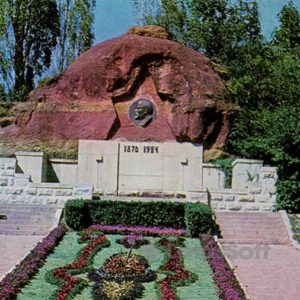
Lenin bas-relief on the red stone. Kislovodsk, 1974
-

Mirror Pond. Kislovodsk, 1974
-

New narzan pump room. Kislovodsk, 1974
-

Prospect them. 50th anniversary of the October Revolution. Kislovodsk, 1974
-

Pyatigorsk. Aeolian Harp, 1963
-

Pyatigorsk. General view, 1963
-

Pyatigorsk. Kolkhoz sanatorium “Fleece”, 1971
-

Pyatigorsk. Lermontov gallery, 1963
-

Pyatigorsk. Monument MY Lermontov, 1963
-

Pyatigorsk. Park, 1963
-

The surrounding area of ??Kislovodsk. Snake Beam, 1963
-

View Kislovodsk, 1963
-

Zheleznovodsk. Park, 1963
-

Zheleznovodsk. Pushkin Gallery, 1963
