
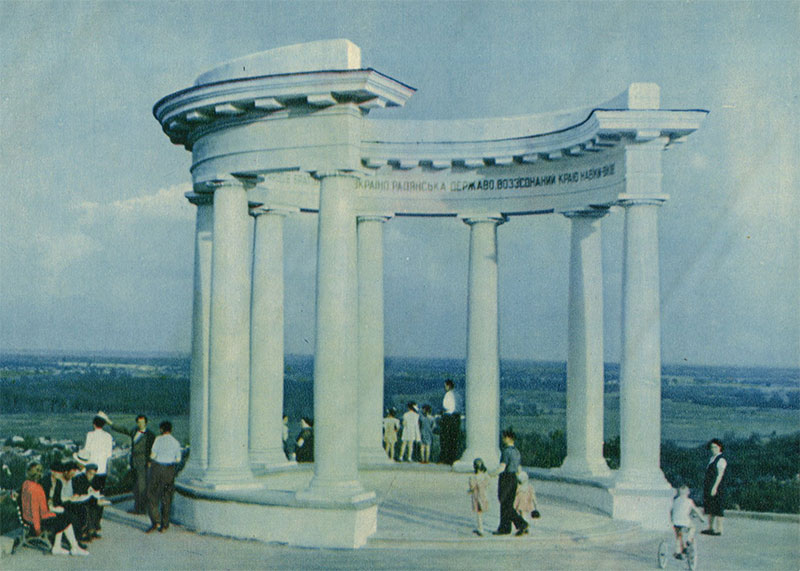
This 1963 Soviet postcard depicts one of Poltava’s central architectural landmarks — the White Arbour, situated on the edge of Ivanova Gora.
What is shown on the postcard
The image shows a semi-circular stone colonnade of eight Doric columns overlooking the steep slope above the Vorskla River. A Soviet-era inscription in Ukrainian is clearly visible on the architrave. Visitors stroll around the viewing platform: a group of people is seated on a bench to the left, several adults and children walk near the columns, and a small child rides a tricycle. In the background, a scenic panoramic view of the low-lying river valley stretches under a bright sky.
Historical note
The original wooden arbour was built in 1909 to mark the 200th anniversary of the Battle of Poltava. During World War II, the structure was completely destroyed by occupying German forces. In 1954, a new reinforced concrete rotunda was erected on the same site, designed by the city’s chief architect, Lev Vaynhort. Its construction was timed to celebrate the 300th anniversary of the Pereyaslav Agreement, which was reflected in its Soviet-era inscription.
Present day
Today, the rotunda remains a key symbol of Poltava and a popular destination for tourists. Following Ukraine’s independence, the Soviet inscription on the inner side of the architrave was replaced with lines from Ivan Kotlyarevsky’s classic play ‘Natalka Poltavka’. In 2008, the monument was equipped with a modern dynamic LED lighting system.
Location (map)
Address: Sobornyi Square, Poltava, Poltava Oblast, Ukraine
Coordinates: 49.589800, 34.568400
(Google Maps)
Coordinate source: Coordinates of the Rotunda of Peoples’ Friendship (White Arbour) on Ivanova Gora in Poltava.
Questions and answers
- When was the stone arbour shown on the postcard constructed? The stone rotunda was built in 1954 to replace the original wooden arbour destroyed during World War II, following a design by architect Lev Vaynhort.
- What inscription was on the rotunda in 1963? During the Soviet period, the architrave featured a patriotic slogan dedicated to the reunification of Ukraine and Russia.
- How has the monument changed in recent times? The Soviet text was replaced with a quote by the writer Ivan Kotlyarevsky, and in 2008, a dynamic LED illumination system was installed.
See also
The «Old Postcards» archive includes other views of Poltava from 1963.

Reviews
There are no reviews yet.