
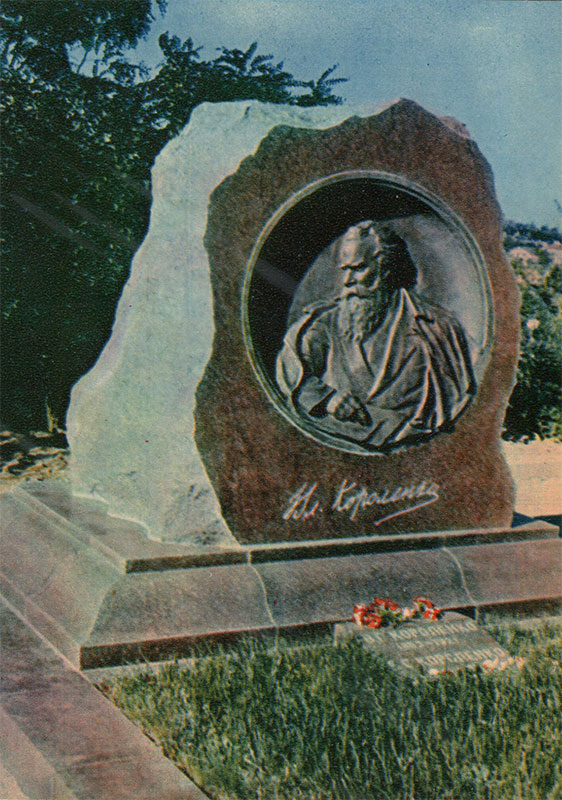
This 1963 collectible postcard depicts the grave monument of the prominent writer and public figure Vladimir Galaktionovich Korolenko in Poltava.
What is shown on the postcard
The image shows the tombstone, designed as a rough block of red granite mounted on a stepped pedestal. In the center of the monolith is a round bronze medallion with a bas-relief profile portrait of the writer, with his facsimile signature below. In the foreground, a small memorial slab with the names of the writer and his wife is visible on a green lawn.
Historical note
V. G. Korolenko spent the last two decades of his life in Poltava, from 1900 to 1921. The writer died on December 25, 1921, and was initially buried in the Old City Cemetery. In 1936, due to the closure and liquidation of the necropolis, his remains were transferred to the territory of the City Garden (now Victory Park), not far from the estate where he lived.
The current design of the burial site, featuring the granite monument with a bronze bas-relief, was established during the Soviet era to replace earlier temporary markers.
Present day
The grave of V. G. Korolenko is located in the Victory Park of Culture and Rest in Poltava. The site holds the status of a historical monument of national importance and is part of the Poltava V. G. Korolenko Literary-Memorial Museum complex. The monument is well-preserved and accessible to visitors.
Location (map)
Address: Victory Park, Shevchenkivskyi District, Poltava, Ukraine
Coordinates: 49.579580, 34.566390
(Google Maps)
Coordinate source: Coordinates of the grave of V. G. Korolenko in Victory Park, Poltava.
Questions and answers
- Where exactly is the grave of V. G. Korolenko located in Poltava? The burial site is located within the territory of the Victory Park of Culture and Rest.
- When were the writer’s remains transferred to the city garden? The transfer from the Old City Cemetery took place in 1936 due to the liquidation of the necropolis.
- What materials were used to construct the grave monument? The monument is made of a rough block of red granite featuring an integrated round bronze medallion.
See also
The «Old Postcards» archive includes other views of Poltava from 1963.

Reviews
There are no reviews yet.