
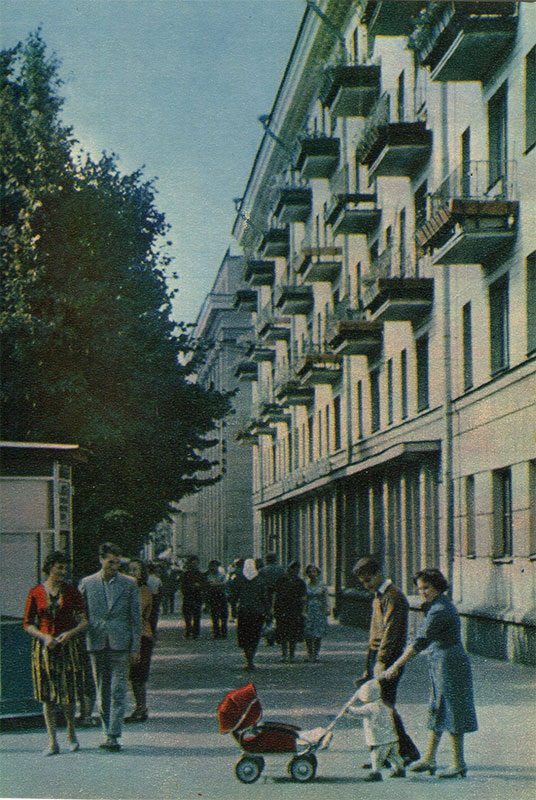
A 1963 Soviet postcard capturing pedestrian traffic on Oktyabrskaya Street (now Sobornosti Street) in Poltava.
What is shown on the postcard
The image displays the right side of the street featuring a multi-story post-war residential building. The facade is adorned with numerous balconies holding flower boxes. The rusticated ground floor houses shop windows. In the foreground, pedestrians walk along the wide sidewalk, including a couple with a red baby stroller, a man and a woman on the left, and other passers-by in summer attire. Lush green trees line the left side, and a columned building facade (the Gogol Theater) is visible in the background.
Historical note
Oktyabrskaya Street (historically Alexandrovskaya, now Sobornosti) was heavily destroyed during World War II. In the late 1940s and 1950s, it was almost entirely reconstructed. The rebuilding project was designed by leading Poltava architects aiming to create a harmonious ensemble in the style of Soviet neoclassicism, featuring extensive greenery and pedestrian infrastructure.
Present day
Today, the street is named Sobornosti Street. The section from Round Square to Sobornyi Square has been turned into a pedestrian zone popular among locals and tourists. The architectural appearance of the post-war residential buildings is largely preserved, though the ground floors are now occupied by modern retail shops and cafes.
Location (map)
Address: 24 Sobornosti St, Poltava, Poltava Oblast, Ukraine
Coordinates: 49.586400, 34.554300
(Google Maps)
Coordinate source: Mapped based on the location of residential buildings opposite the Poltava Academic Music and Drama Theater (24 Sobornosti St)..
Questions and answers
- Which building is visible in the background of the postcard? In the distance behind the trees, the side facade of the Poltava Academic Ukrainian Music and Drama Theater named after M.V. Gogol can be seen.
- What is the current name of Oktyabrskaya Street? Today, this central street of Poltava is renamed Sobornosti Street.
- What architectural style does the residential building in the photo represent? The residential building was built in the post-war Soviet neoclassicism (Stalinist empire) style, characterized by a rusticated ground floor and a rhythmic layout of balconies.
See also
The «Old Postcards» archive includes other views of Poltava from 1963.

Reviews
There are no reviews yet.