
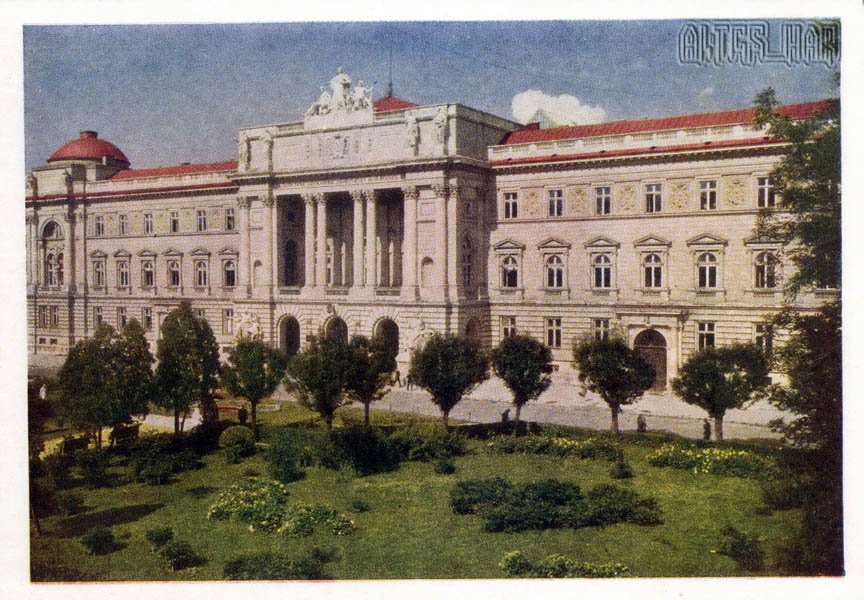
A 1960 Soviet color postcard depicting the main building of the Ivan Franko State University of Lviv, located opposite the park.
What is shown on the postcard
The postcard shows the main facade of the monumental three-story Neo-Renaissance building. Three arched portals mark the entrance, topped by a loggia with Corinthian columns and an attic featuring a sculptural group. A green square (now Ivan Franko Park) with trimmed trees, shrubs, and walking figures is visible in the foreground.
Historical note
The building was constructed in 1877–1881, designed by architect Juliusz Hochberger to house the Galician Sejm (regional parliament). Following the collapse of Austria-Hungary and the transition of the city to Polish rule in 1920, the building was handed over to the Jan Kazimierz University. Since 1940, the institution has been named after the Ukrainian writer Ivan Franko.
Present day
Today, this is the main building of the Ivan Franko National University of Lviv. The architectural complex is fully preserved, with a monument to Ivan Franko (unveiled in 1964) now standing in the plaza in front of it, and the adjacent park remaining a popular recreation spot.
Location (map)
Address: 1 Universytetska St, Lviv, Lviv Oblast, Ukraine
Coordinates: 49.840200, 24.022500
(Google Maps)
Coordinate source: Coordinates of the main building of the Ivan Franko National University of Lviv.
Questions and answers
- What is the architectural style of the building? The building is designed in the Neo-Renaissance style.
- What was the original purpose of the building? It was built in 1877–1881 as the seat of the Galician Sejm (regional parliament).
- When did the university receive the name of Ivan Franko? The institution has been named after Ivan Franko since 1940.
See also
The «Old Postcards» archive includes other views of Lviv from 1960.

Reviews
There are no reviews yet.