
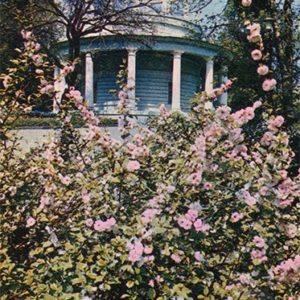
A postcard from the “Old Postcards” archive featuring a panoramic view of the Nizami Museum in Baku, issued in 1970.
What is shown on the postcard
The panoramic image shows a city square with green spaces, alleys, and pedestrian paths. On the right, the monumental building of the Nizami Museum of Azerbaijani Literature is visible with its characteristic arch elements and national ornamentation on the facade. On the left, a fragment of a monument on a pedestal can be seen. Pedestrians walk along the sidewalk, and a car is noticeable on the roadway.
Historical note
The museum building is located in the historical center of Baku and has a rich architectural history. Originally built in the 1860s as a two-story caravansarai, it was reconstructed in the late 1930s into a literary museum dedicated to the classic poet Nizami Ganjavi. The reconstruction project was developed by architects Sadikh Dadashov and Mikayil Useynov, enriching the building’s appearance with Eastern architectural motifs.
Present day
Currently, the square and the Nizami Museum building have preserved their historical appearance, remaining one of the main cultural and architectural landmarks of the capital of Azerbaijan. The surrounding infrastructure and green area were modernized during large-scale urban landscaping projects.
Location (map)
Address: Fountains Square / Nizami St, Baku, Azerbaijan
Coordinates: 40.368600, 49.835100
(Google Maps)
Coordinate source: Nizami Museum of Azerbaijani Literature, Baku.
Questions and answers
- What year is indicated on the postcard? The year indicated on the postcard is 1970.
- What landmark is depicted on the right side of the postcard? The Nizami Museum of Azerbaijani Literature is depicted on the right side.
- In which city was the photo taken? The photo was taken in Baku, the capital of Azerbaijan.
See also
The «Old Postcards» archive includes other views of Baku from 1970.




Reviews
There are no reviews yet.